Who Controls Venezuela’s Oil After Maduro Arrest?
Who Controls Venezuela’s Oil After Maduro Arrest?


Jan 5, 2026
·0 min read




The U.S. operation against Venezuelan president Nicolás Maduro has thrown one of the world’s most politically fraught oil industries back into focus, forcing investors to reassess who controls the country’s crude resources and whether they can be meaningfully revived after decades of decline.
For now, the answer may seem straightforward. “Petróleos de Venezuela (PDVSA), the state-owned oil company, controls the majority of the oil production and reserves,” said Andy Lipow, president of Lipow Oil Associates.
American energy corporation Chevron operates in the country through its own production and a joint venture with PDVSA, while Russian and Chinese firms also participate through partnerships, though “majority control is still with PDVSA,” Lipow said. Chevron was up more than 6% premarket as of 8 a.m. ET on Monday.
Venezuela nationalized its oil industry in the 1970s, which led to the creation of PDVSA. Oil output peaked at about 3.5 million barrels per day in 1997, but has since plunged to an estimated 950,000 barrels per day, with around 550,000 barrels per day exported, data provided by Lipow Oil Associates shows.
If a more pro-U.S. and pro-investment government takes shape, Chevron would be “best placed” to expand its role, said Saul Kavonic, head of energy research at MST Financial. European companies like Repsol and Eni could also benefit, given their existing positions in Venezuela, he said.
What it means for global oil
Any regime change could disrupt the commercial chain that keeps Venezuelan barrels flowing, industry experts warned.
“Since it is unclear at this time who is in charge in Venezuela, we might see exports completely halt as the buyers don’t know to whom to send the money,” said Lipow. He added that the latest round of U.S. sanctions on a shadow fleet of tankers has severely affected exports, forcing Venezuela to cut production.
The shadow fleet refers to tankers that operate outside traditional shipping, insurance and regulatory systems to move crude from sanctioned countries. These vessels are commonly used to transport oil from nations such as Venezuela, Russia and Iran, which face U.S. restrictions on energy exports.
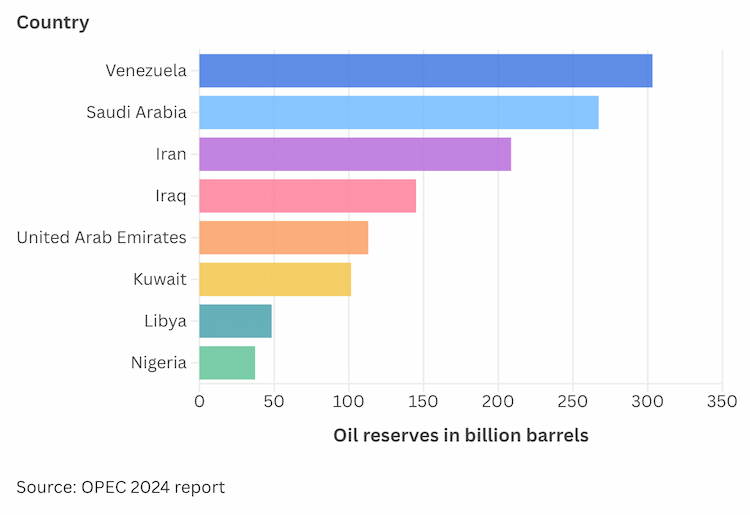
Venezuela has the world's largest proven oil reserves
Lipow expects Chevron to continue exporting 150,000 barrels per day, limiting any immediate supply impact. Still, he said the broader uncertainty could add a short-term risk premium of about $3 per barrel.
That bump would come against a market that many analysts see as adequately supplied, at least for now. “The oil market currently is trending towards oversupply,” Rapidan Energy Group’s Bob McNally said, calling the immediate impact “almost a nothing burger.”
Venezuela’s longer-term importance lies in the type of oil it produces. The country’s heavy, sour crude can be challenging to extract, but prized by complex refineries, particularly in the U.S. “American refineries... love to slurp that gunky oil from Venezuela and Canada,” McNally said.
“The real issues are, will the oil industry be able to get back into Venezuela and reverse two decades of dilapidation and neglect and get it back up?”
If opposition leader Maria Corina Machado is installed as president very quickly, sanctions could ease and oil exports could initially rise as stored oil is used to generate revenue, Lipow said. However, a short-term surge could pressure prices, he added.
International benchmark Brent crude oil futures with March delivery were up 0.5% at $61.03 per barrel, while U.S. West Texas Intermediate futures with February delivery stood 0.6% higher at $57.64.
Still, any notion of a sustained recovery faces hard physical limits. “The Venezuelan oil industry is in such a state of disrepair that even with a change in government, it is unlikely to see any material increase in oil production for years as substantial investments are required to rehabilitate the existing infrastructure,” he noted.
Similarly, RBC’s Helima Croft warned that the path to recovery is long, citing Venezuela’s “decades-long decline under the Chávez and Maduro regimes.” She said that oil executives contend it will cost at least $10 billion annually to turn the sector around, with “a stable security environment” an absolute prerequisite.
“All bets are off in a chaotic change of power scenario like what occurred in Libya or Iraq,” she said.
Clintons Agree to Testify in Epstein Probe
Feb 3, 2026
2 min
India Drops Russian Oil; Trump Slashes Tariffs
Feb 3, 2026
2 min
Dem Flips Deep-Red Texas Senate Seat
Feb 3, 2026
2 min
CBS News Weighs Firing Attia Over Epstein Emails
Feb 3, 2026
1 min
Emails: Epstein Had a Secret Child
Feb 3, 2026
3 min
Emails: Melania Praised Epstein Article to Maxwell
Feb 3, 2026
2 min
Billie Eilish Blasted for "Fuck ICE" Speech
Feb 3, 2026
1 min
TODAY Anchor Savannah Guthrie’s Mom Likely Abducted
Feb 3, 2026
2 min
Judge Refuses to Halt ICE Operation in MN
Feb 1, 2026
2 min
Senate Passes $1.2T Govt Funding Deal
Feb 1, 2026
4 min
US, Israel Deny Role in Deadly Iran Blasts
Feb 1, 2026
1 min
Ghislaine: 29 Epstein Friends Cut Secret Deals
Feb 1, 2026
2 min
Epstein Photo: Andrew on All Fours Over Woman
Feb 1, 2026
2 min
Judge Blocks Trump’s Citizenship Voting Rules
Feb 1, 2026
2 min
Moltbook: The Social Network Where Humans Can’t Post
Feb 1, 2026
3 min
Detransitioner Wins $2M in Historic Malpractice Verdict
Feb 1, 2026
2 min
Feds Arrest Don Lemon Over MN Church Protest
Jan 30, 2026
2 min
DOJ Releases 3M Epstein File Pages
Jan 30, 2026
5 min
Trump Taps Kevin Warsh for Fed Chair
Jan 30, 2026
6 min
Partial Shutdown Likely Tonight Despite Senate Deal
Jan 30, 2026
2 min
